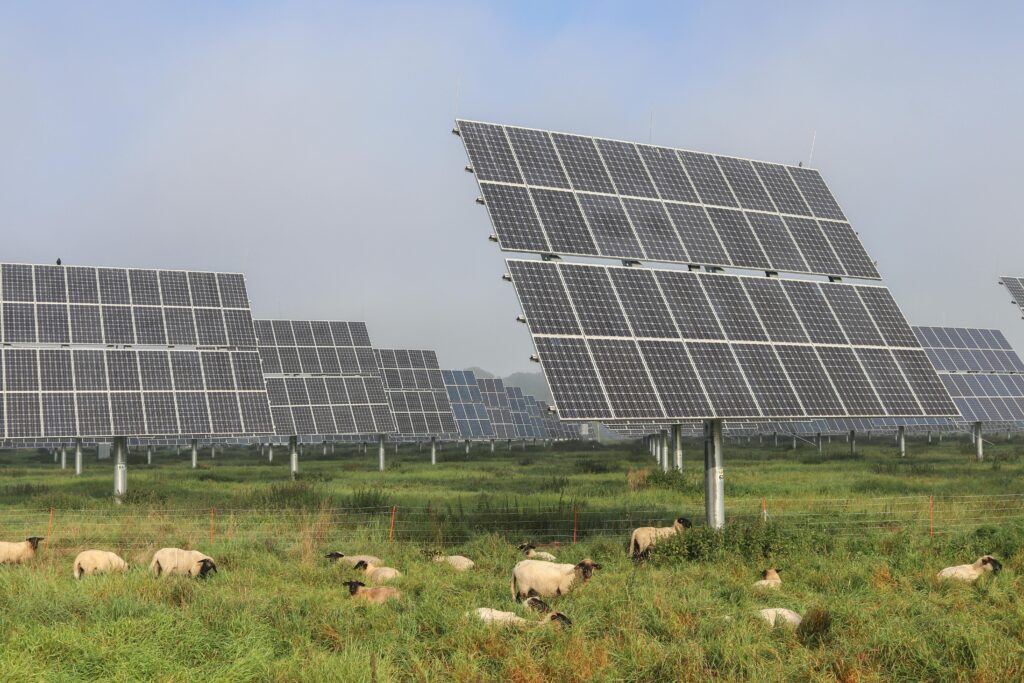
Renewable Energy Efficiency in Agricultural Facilities: Integration of Energy Production and Agriculture
Agricultural facilities — including greenhouses, livestock farms, irrigation systems, cold storage warehouses, feed mills, and food processing plants — are high-energy consumers. Rising fossil fuel costs, increasing volatility in energy markets, and climate-related risks make these facilities ideal candidates for renewable energy integration. By combining energy production with agricultural operations, farms can significantly improve both economic efficiency and environmental performance.
This article outlines the technical potential of renewable energy solutions in agriculture, based on international best practices and recent reports from REN21, Fraunhofer ISE, and others.
Energy Demands in Agricultural Facilities
The main energy loads in agricultural operations typically include:
- Heating and cooling: greenhouses, livestock shelters, cold storage, food processing
- Pumping and water management: irrigation pumps, aquaculture aeration
- Ventilation and air circulation: fans, cooling pads, barn ventilation
- Lighting: LED systems in greenhouses, barns, and warehouses
- Processing and preservation: drying, milling, pasteurization, refrigeration
These loads are energy-intensive, continuous, and in many cases seasonal. For example, greenhouses may require up to 350–500 kWh/m² per year for heating in colder climates, while cold storage warehouses consume 30–50 kWh/m³ per year for refrigeration.
Key Renewable Energy Technologies for Agriculture
1. Photovoltaics (PV)
- Rooftop PV or agrivoltaics (APV) systems can supply electricity directly to on-site loads.
- A typical 1 MWp PV plant produces 1,200–1,500 MWh/year in Central Europe; in sunnier regions this can exceed 1,800 MWh/year.
- PV integration reduces grid dependence and can directly power irrigation pumps or cooling units during peak solar hours.
- Agrivoltaic systems provide partial shading, which can reduce evapotranspiration by up to 20%, improving water efficiency.
2. Solar Thermal Heating
- Solar thermal collectors can provide hot water for cleaning, animal husbandry, or low-temperature process heat.
- In greenhouses, solar thermal systems can pre-heat water for floor heating or air heaters, reducing natural gas demand by 20–40%.
3. Geothermal / Ground-Source Heat Pumps
- Ground-source heat pumps (GSHP) use shallow geothermal energy (100–200 m boreholes or horizontal loops) to supply stable low-temperature heat.
- COP (Coefficient of Performance) typically ranges from 3.5–5.0, meaning 1 kWh of electricity provides 3.5–5 kWh of heat.
- For greenhouses and livestock housing, GSHPs can stabilize indoor climate while reducing CO₂ emissions compared to boilers.
4. Biogas / Biomethane
- Anaerobic digestion of manure and agricultural residues produces biogas (50–65% methane).
- A 500-cow dairy farm can produce about 1,000–1,200 m³ of biogas/day, equivalent to 2–2.5 MWh/day of electricity in a CHP unit.
- Digestate can be used as a nutrient-rich fertilizer, closing the nutrient cycle.
5. Thermal and Electrical Storage
- Hot water tanks (200–1,000 m³) for greenhouses allow time-shifting of solar or biomass heat.
- Battery storage (typically 0.5–2 hours of load coverage) can bridge short-term imbalances, stabilize irrigation pumping, or improve self-consumption of PV.
Integration Strategies
- PV + Heat Pump Hybrid Systems
- PV supplies electricity to GSHPs during daytime.
- COP 4 heat pump with 100 kW electrical input provides 400 kW thermal output.
- Excess PV can charge short-term batteries or feed the grid.
- Agrivoltaics (APV)
- Panels mounted at 2–5 m height, covering 30–40% of land area.
- Crop yields: slight reductions (−5 to −15%) for light-intensive crops; neutral or positive (+5 to +15%) for shade-tolerant crops (leafy greens, forage).
- Land Use Efficiency (LUE) can exceed 160%, compared to single-use farming.
- Biogas CHP + Heat Recovery
- Biogas engine produces electricity (35–40% efficiency) and heat (45–50% efficiency).
- Total system efficiency >80%.
- Ideal for dairy or poultry farms with steady manure supply.
- Thermal Storage for Greenhouses
- Solar thermal collectors charge hot water buffer tanks (e.g., 500 m³).
- Storage capacity ~250–350 kWh/°C. A 20 °C delta T yields ~7 MWh of usable heat.
Benefits of Renewable Integration
- Cost Reduction: Levelized Cost of Energy (LCOE) for PV is now below €40/MWh in many regions, lower than grid tariffs.
- Yield Improvement: Shading reduces water stress, improves soil moisture, and increases crop resilience under climate change.
- Grid Stability: Agricultural PV systems can provide demand-side flexibility, e.g., aligning irrigation pumping with solar output.
- Environmental Benefits: Up to 60–80% CO₂ reduction when replacing fossil-based heating.
- Additional Revenue Streams: Surplus electricity sold to grid; biomethane upgraded and injected into gas networks.
Case Example: Fraunhofer APV-Resola, Heggelbach, Germany
- Installed Capacity: 194 kWp PV system over 0.33 hectares.
- Crops tested: wheat, potatoes, clover, celery. FraunhoferISE+2
- Results:
- Land Use Efficiency increased by +60%.
- Celery yield improved under partial shading.
- PV generated ~1,260 kWh/kWp annually, enough to cover irrigation and processing loads.
Challenges and Barriers
- High upfront CAPEX for geothermal or large-scale agrivoltaics.
- Policy and regulatory gaps in land-use and grid connection.
- Technical knowledge: farmers need training and service support for O&M.
- Crop compatibility: system design must consider crop-light interaction, microclimate, and irrigation adjustments.
Conclusion
Renewable energy systems — PV, geothermal, biogas, solar thermal, and hybrid storage — can dramatically improve the energy efficiency, sustainability, and profitability of agricultural facilities. International examples demonstrate that agricultural production and renewable energy generation are not competing but synergistic activities.
The next step is tailoring these technologies to local conditions, such as Turkey’s solar resources, geothermal potential, and agricultural patterns, to unlock their full potential.